Collector Guide
How to Spot a Fake Pokémon GBA Game
Pokémon Game Boy Advance games are some of the most counterfeited games ever made. Before you buy Emerald, FireRed, LeafGreen, Ruby or Sapphire, run through these checks — most fakes fail two or three of them.
Step-by-step checks
1. Label print and finish
Real: Sharp, evenly colored artwork with crisp small text. The label sits flat and straight in its recess, and the tiny product code (for example AGB-BPEE-USA for Emerald) is printed clearly along the bottom edge.
Fake: Blurry or pixelated art, colors that look washed out or too saturated, an overly glossy sticker, fuzzy small print, a missing or wrong product code, or a label that is crooked or peeling.
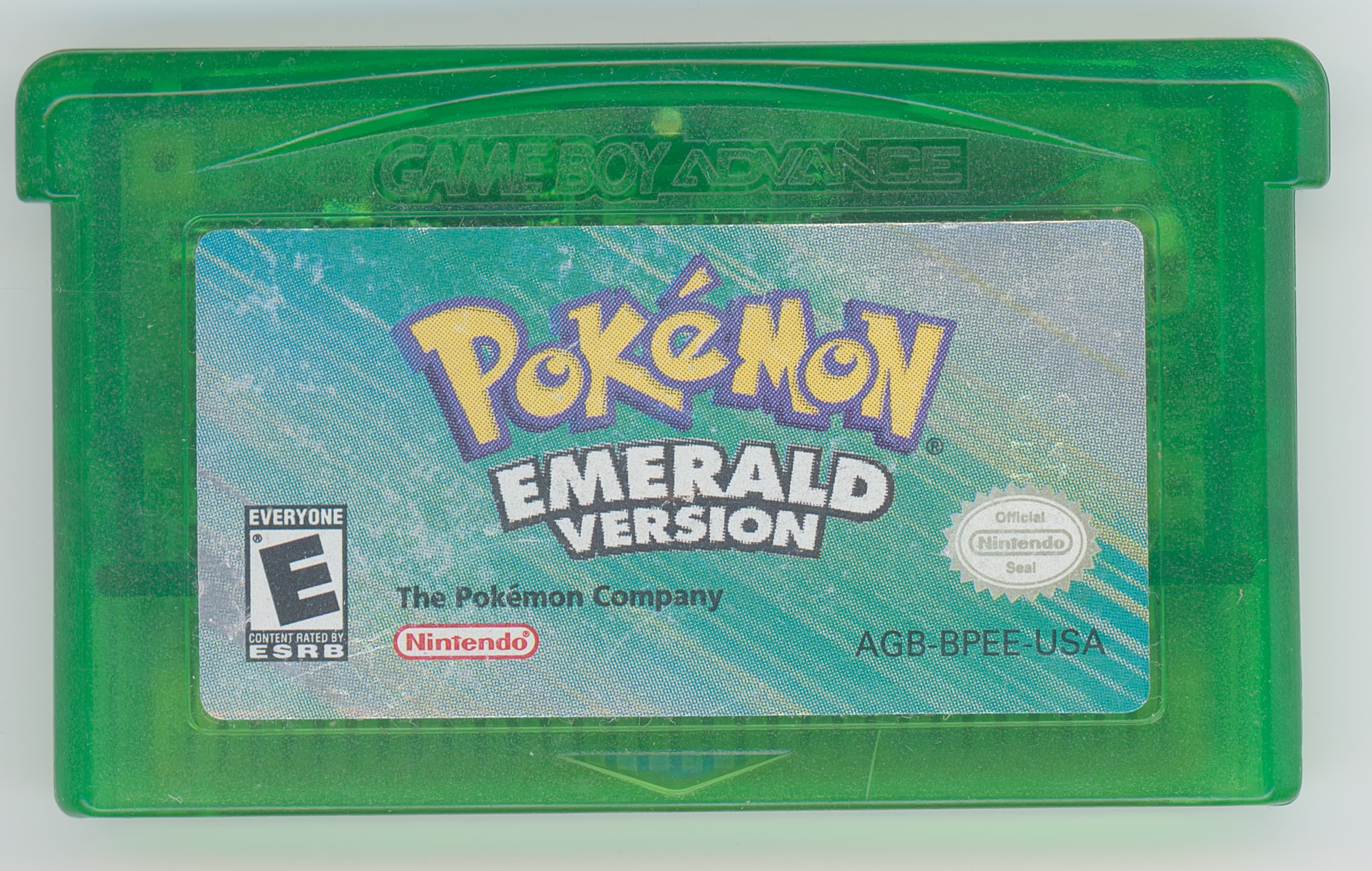
English US Pokémon Emerald label: AGB-BPEE-USA appears at the lower right, the ESRB E rating at the lower left, and GAME BOY ADVANCE is raised above the label. Compare the exact game and region, not just the green shell. Genuine reference example—not a fake comparison.
Photo: FexCollects / Game Boy hardware database (gbhwdb.gekkio.fi), CC BY-SA 4.0. Unmodified.
2. The copper coin battery you can see through the shell
Real: Ruby, Sapphire and Emerald run a small clock battery, and you can spot it without a screwdriver: hold the cart up to a lamp and look through the back of the shell. A genuine copy shows a round, copper-colored coin cell sitting flat on the board. If that copper disc is there, the cart is almost certainly real.
Fake: No copper coin cell visible at all is one of the fastest tells — Ruby, Sapphire and Emerald always have one. A cell that looks glued or taped down, or a black blob of epoxy or glue where it should sit, is just as bad: bootlegs sometimes press a dummy battery in to pass a quick look.
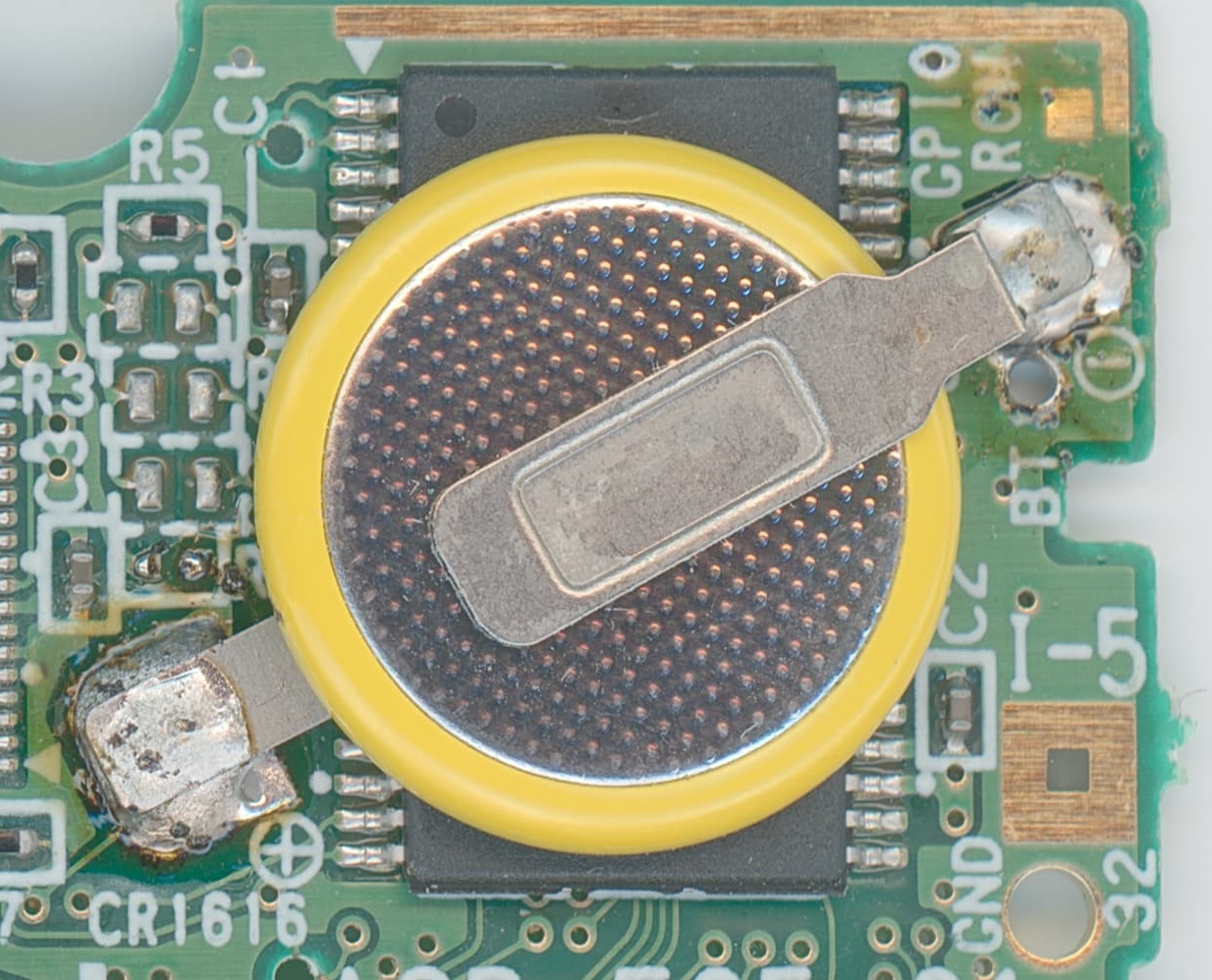
Battery detail from an English Pokémon Ruby board: the round coin cell sits beneath its metal tab. This copy has a yellow-rimmed replacement cell; battery color can vary. The shell is removed so you can see its location clearly—this is not a through-shell photograph. A battery alone cannot prove authenticity, and a dead battery does not make a cartridge fake.
3. Molded number on the front
Real: Genuine GBA shells have a small one- or two-digit number molded into the plastic on the front, just below the label.
Fake: No molded number at all is one of the most common giveaways on bootleg shells.
4. Back of the shell and screw
Real: Clean embossed Nintendo text and the model number AGB-002 on the back, held together with a tri-wing (Y-shaped) security screw.
Fake: Soft or shallow lettering, rough plastic seams, and often a regular Phillips screw — or no screw at all.
5. The circuit board (if you can open it)
Real: A green board with Nintendo printed on it, a part number starting with AGB-E, and labeled chips with date codes. Ruby, Sapphire and Emerald also carry a small coin battery for the in-game clock.
Fake: A plain board with a black blob of epoxy covering the chip, no Nintendo marking, and no battery on Ruby, Sapphire or Emerald.

English Pokémon Ruby board detail: ©2002 Nintendo and AGB-E05-01 run along the bottom above the gold contacts. The labeled chips and clock battery are visible. Compare with the correct Pokémon game’s board layout; genuine revisions and battery replacements can differ.
Photo: FexCollects / Game Boy hardware database (gbhwdb.gekkio.fi), CC BY-SA 4.0. Unmodified.
6. Weight and fit
Real: Feels solid and slides into a Game Boy Advance snugly.
Fake: Noticeably lighter, rattles, or fits loosely or too tight in the slot.
7. Play and save test
Real: Boots to the correct title screen, plays without glitches, and saves normally. On Ruby/Sapphire/Emerald the berry and tide clock events keep time as long as the clock battery is fresh.
Fake: A wrong or generic boot screen, a game that freezes or won't save at all, or a save that still disappears after you fit a new battery — that's a strong repro sign.
Quick red flags
- Ruby, Sapphire or Emerald with no copper coin cell visible through the back of the shell.
- A 'sealed' Emerald, FireRed or LeafGreen far below going prices.
- The same seller has many identical copies in perfect condition.
- Listing photos are stock images instead of the actual cartridge.
- Seller refuses to show the back of the cart or the label up close.
- Shipped from overseas as 'new' with no box or a flimsy reprinted box.
Common questions
Which Pokémon GBA games get faked the most?
Emerald, FireRed, LeafGreen, Ruby and Sapphire are the most counterfeited because they're the most in demand. Pokémon Mystery Dungeon: Red Rescue Team is faked too.
Is a fake Pokémon Emerald worth anything?
Not as a collectible. Many fakes also lose saves or break clock-based events, so it isn't a great copy to play either.
Can a real cartridge have a replaced battery?
Yes. Ruby, Sapphire and Emerald batteries die over time and are often replaced, and on those three you can usually see the new cell through the back of the shell. A clean, flat-fitting cell on an otherwise genuine board is fine and doesn't make the game fake — glue, tape or black goop around it is the bad sign.
The clock has stopped and saves don't hold — is my game fake?
Not necessarily. A dead clock battery is completely normal on a cartridge this old and is one of the cheapest fixes there is: the in-game clock stops and saves may not hold until a new cell goes in. Judge the cart on the shell, label and board checks instead — plenty of genuine copies arrive with a spent battery.
Do Japanese Pokémon GBA games work on a US Game Boy Advance?
Yes. The Game Boy Advance is region-free, so Japanese copies play on any GBA, GBA SP, Game Boy Micro, DS or DS Lite.
Shop with confidence
Every listing shows real photos of the exact copy you get. Want a closer look at a label or board? Ask us before you buy.
Also read: How to spot fake Pokémon DS games